
Overstimulation in Dogs: Why It Happens, What It Looks Like, and How to Bring Your Dog Back to Center
Learn how overstimulation affects your dog's behavior, energy, and ability to learn. Discover signs of stress and practical ways to help your dog reset and stay calm. Expert insights from Dynamic K9 in Tampa.
John A.
12/2/20254 min read
As dog owners, we often assume the more activity we give our dogs, the better. But there’s a line. When crossed, that well-meaning stimulation can actually overload your dog’s nervous system, making it hard for them to function, behave, or even feel safe.
Understanding overstimulation is a game-changer. It explains so many of the “bad” behaviors owners struggle with: reactivity, barking, poor focus, and more. This blog breaks down the real reasons dogs get overstimulated, how to recognize it, and, most importantly, how to help your dog reset.
🔎 What Does Overstimulation in Dogs Really Mean?
Overstimulation isn’t just “too much excitement.” It’s a neurological and emotional overload. Your dog’s brain is processing more than it can handle in that moment. They become flooded, reactive, or shut down.
Imagine sitting at home watching your favorite action movie on surround sound, blasting hard rock from a Bluetooth speaker, listening to an audiobook through your earbuds — all while your kids are running around screaming and playing. Now try to write an important work email in the middle of all that.
You know how to write. You’ve done it a thousand times. But your brain is overstimulated: too much noise, too many inputs, no space to focus.
That’s exactly what it feels like for a dog that’s overloaded by their environment.
⚡ Common Triggers of Overstimulation
Some dogs are naturally more sensitive, but here are situations that commonly lead to overload:
• Busy Environments
Crowded parks, city streets, festivals, events, chaotic homes. All are full of new sounds, smells, people, and dogs.
• Repetitive High-Arousal Activities
Constant ball throwing, nonstop tug games, or endless roughhousing raise arousal but don’t teach recovery. Without a cooldown, dogs stay “stuck on high.”
• Meeting Too Many People or Dogs at Once
Dogs need time to decompress between new encounters. Flooding them with stimuli can lead to reactivity or anxiety later.
• Poorly Structured Training
Too long, too hard, too confusing. Training without balance or clarity exhausts the dog’s mind and builds frustration.
• Over-Enriched Puppies
Puppies exposed to everything without learning how to process or settle often become anxious adults who can’t regulate themselves.
🧠 How Overstimulation Affects Learning and Behavior
When a dog is overstimulated, their limbic brain (emotional/instinctive) takes over, and executive function (logic and learning) shuts down. That’s why:
They forget basic commands
They ignore you when they “know better”
They bark, lunge, bite the leash, or act wild
They become jumpy, clingy, or even aggressive
This isn’t disobedience. This is an inability to process.
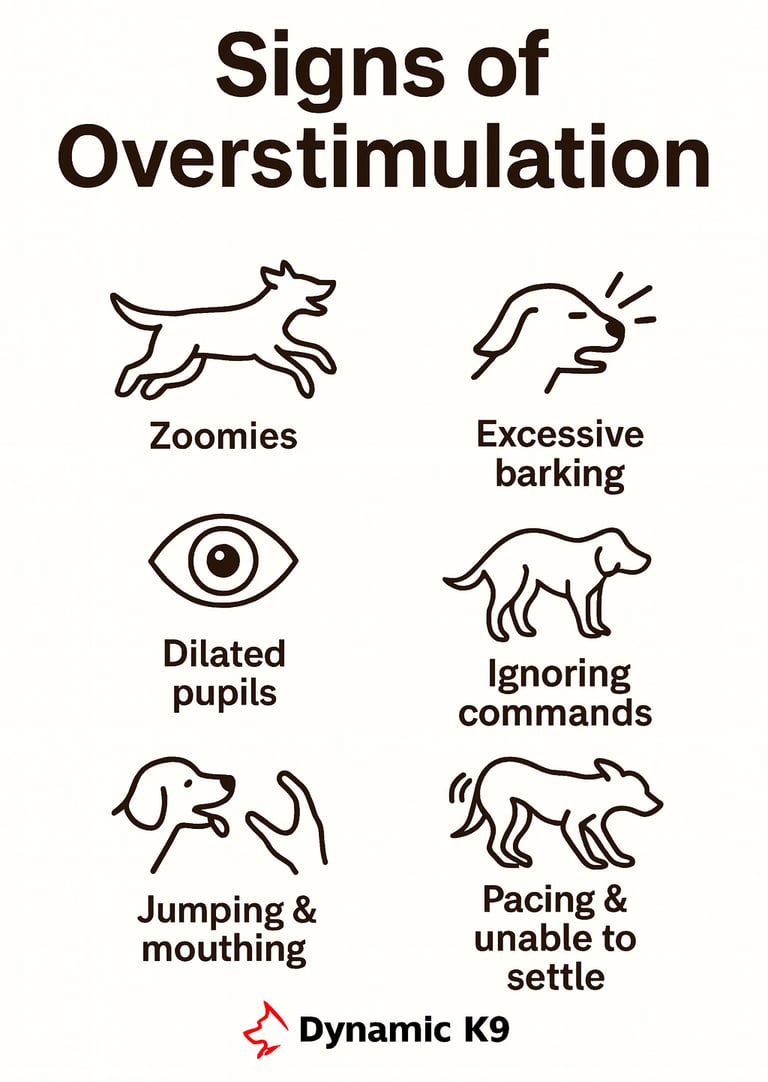
📖 Signs of an Overstimulated Dog
Some signs are dramatic. Others are subtle. Look for:
🚨 Rapid eye movement / dilated pupils
🗣 Excessive barking, whining, or vocalizing
🌀 Spinning, zooming, jumping, pacing
🫨 Unable to settle after activity or stimulation
🛑 Freezing, lip-licking, yawning (stress signals)
🧩 “Forgetfulness” of known commands
🧍♂️ Velcro behavior or panicky attachment
💥 Explosive reactions to small triggers
If your dog “loses their mind” after a trip to the dog park or walks away from training sessions more wired than when they started, you’re probably seeing overstimulation in action.
🐾 Why Some Dogs Are More Prone to Overstimulation
Not every dog reacts the same way. Some factors that affect sensitivity include:
• Breed Traits
Working, herding, and guarding breeds tend to have higher arousal and are more reactive to stimuli.
• Age
Puppies and adolescent dogs (under 2 years) often lack the ability to self-regulate.
• Previous Experiences
Rescue dogs, undersocialized dogs, or dogs with trauma histories may have lower stimulation thresholds.
• Lack of Leadership or Structure
Without clear direction, dogs become self-reliant and hyper-vigilant. This often leads to overload.
• Unstructured Lifestyles
Dogs without daily decompression, consistent routines, or boundaries tend to stay in a reactive state.
🧘♂️ How to Help a Dog Recover from Overstimulation
1. Stop Adding More
The biggest mistake owners make is adding stimulation to “tire them out.” A dog in an overstimulated state doesn’t need more activity. They need regulation.
2. Create Calm Spaces
Use crates, place beds, low lighting, and quiet music to help soothe the nervous system. This isn’t punishment. It’s a reset.
3. Use Leashed Calm Time
Instead of free-roaming chaos, teach your dog to relax on leash at your side or on a designated bed. Reward the mental state, not the movement.
4. Shorten Training Sessions
Don’t wait until your dog crashes. Train in small chunks (5–10 minutes), then give breaks. Avoid overloading the brain.
5. Introduce “Doing Nothing” Exercises
Take your dog somewhere quiet and let them exist. No commands, no play — just watching the world. This builds resilience.
6. Address Your Own Energy
If you’re anxious, rushed, or overstimulated, your dog mirrors that. The calmer you are, the calmer they’ll become.
7. Build a Recovery Routine
After play, outings, or training, give 10–15 minutes of structured calm time. This teaches your dog how to come down instead of spiraling up.
🧩 Bonus Tip: Focus on the Mental State, Not Just the Behavior
You can correct a bark or a jump. But if you don’t address the underlying state, the behavior just finds a new outlet.
Training that builds calmness, confidence, and clarity is what creates lasting change.
🎯 The Dynamic K9 Approach: Clear Minds, Confident Dogs
At Dynamic K9, we specialize in helping dogs go from reactive, hyper, or chaotic to calm, confident, and connected.
Our training isn’t just about obedience. It’s about understanding what your dog needs mentally and emotionally so they can learn and thrive.
Whether you’re working through reactivity, leash pulling, overexcitement, or just want a calmer home — we build custom programs that create real transformation.
📍 Based in Tampa, Florida
📲 Contact us today to schedule a consultation or find the right program for your dog.